Welcome to Game Translate – Why I Started This Site
Welcome to Game Translate.
This website started from a simple hobby: I love old games, especially Japanese games that never received an official English release.
For years, I have enjoyed exploring games from the PlayStation era and other classic systems. Some of the most interesting games I found were never localized, or only had partial fan translations, old patches, incomplete guides, or information scattered across forums that are becoming harder to find.
At some point, simply playing these games was no longer enough.
I wanted to understand how they worked.
And eventually, I wanted to translate them.
Why Game Translation?
There is something special about discovering a game that most players outside Japan never had the chance to experience properly.
Sometimes the graphics are great. Sometimes the battle system is unique. Sometimes the story looks interesting even when you cannot understand a single line of dialogue.
But the language barrier changes everything.
Menus become trial and error. Story scenes are impossible to follow. Item descriptions, character abilities, tutorials, and important gameplay information are hidden behind Japanese text.
That is where translation projects become interesting to me.
A translation patch can give an old game a completely new life.
It can turn something that was previously difficult to approach into a game that thousands of new players can finally understand and enjoy.
That idea is what made me interested in game translation.
From Playing Games to Looking Inside Them
When I first started, I thought translating a game would mostly mean extracting Japanese text, translating it into English, and putting it back.
It quickly became obvious that it was much more complicated than that.
Old games were rarely designed with fan translation in mind.
Text may be stored inside large binary files. Characters can use custom encoding. Fonts may be stored as graphics. Menus may have strict space limitations. English text can be much longer than the original Japanese. Some games use pointers, compression, control codes, or completely custom data structures.
Even something as simple as changing a menu option can become a small puzzle.
That is actually one of the parts I enjoy most.
A translation project is not only about language. It is also about reverse engineering, problem solving, testing, graphic editing, scripting, and sometimes finding creative ways around limitations that were built into a game decades ago.
My Translation Process
My workflow changes depending on the game, but most projects follow a similar path.
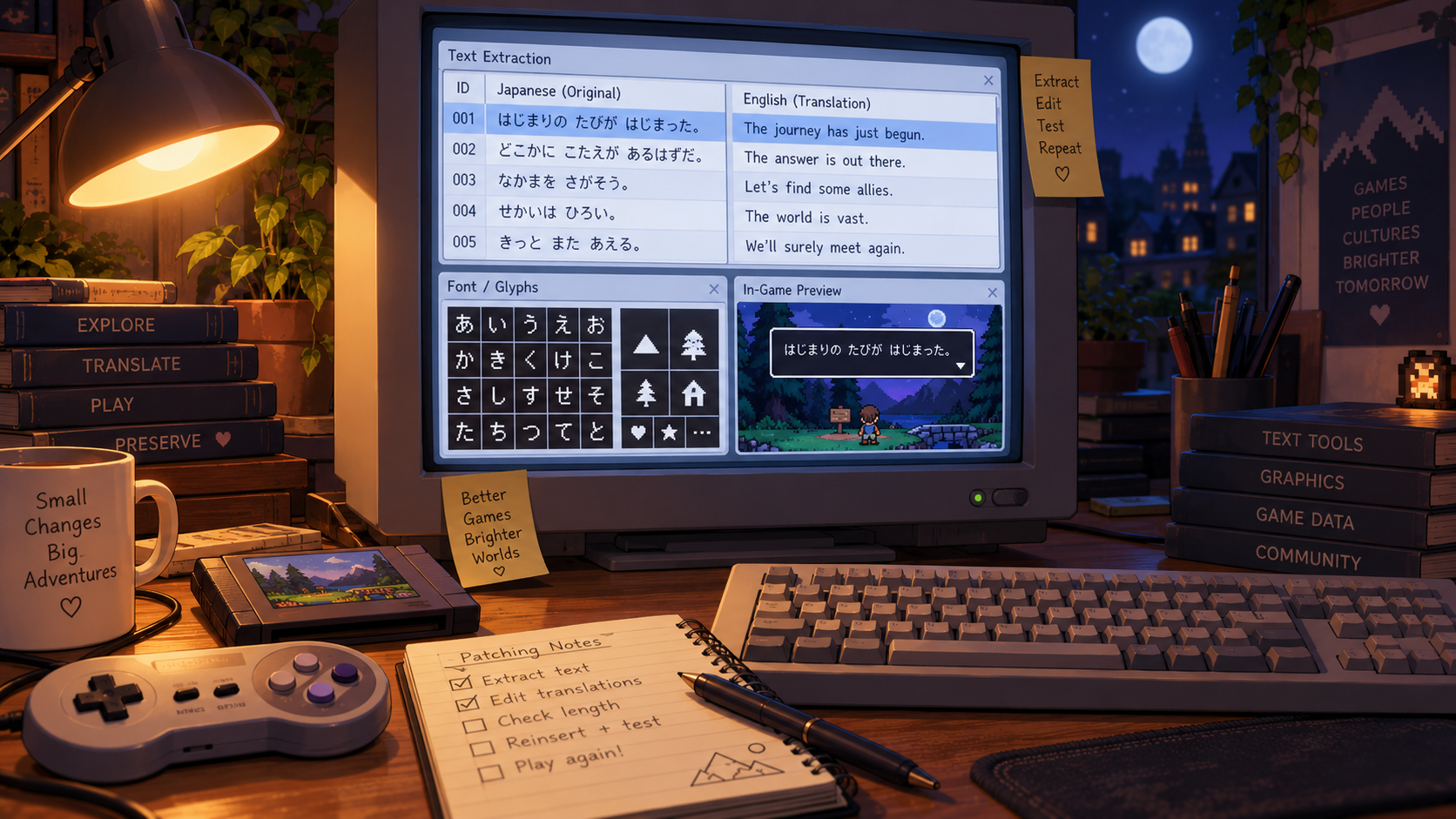
First, I explore the game files and try to identify where the text, graphics, fonts, and interface data are stored.
Then I extract as much text as possible into a format that is easier to work with.
From there, the translation process begins.
But translating the meaning of a sentence is only part of the job.
The new text also has to fit inside the game.
That may mean shortening menu labels, adjusting terminology, modifying fonts, changing text width, rebuilding files, or rewriting parts of the game so that longer English text can be displayed correctly.
After that comes testing.
A lot of testing.
Menus need to be checked. Dialogue needs to display correctly. Text cannot overlap UI elements. Control codes have to remain intact. Save files, battles, events, and different game screens all need to behave normally.
Sometimes a single incorrect byte can break an entire screen.
Other times, a small visual problem leads to hours of investigation.
It can be frustrating, but solving those problems is also incredibly satisfying.
One of My Current Projects
One of the projects that pushed me deeper into this hobby is Super Robot Wars F on the original PlayStation.
Games like this are a perfect example of why fan translation can be challenging.
There is a huge amount of text, many menus, character and unit names, battle interfaces, equipment screens, dialogue scenes, and countless small UI elements that were designed specifically around Japanese text.
Replacing Japanese characters with English while keeping everything readable requires much more than a direct translation.
Sometimes the challenge is not translating the words.
The challenge is making those words physically fit on the screen.
Working on projects like this has taught me a lot about PS1 game data, fonts, text encoding, interface layouts, and the strange little tricks developers used to save space.
I plan to document many of those discoveries here.
What You Will Find on Game Translate
Game Translate is mainly a personal blog where I can document what I learn while working on game translation projects.
You will find posts about:
Translations
Updates, discoveries, screenshots, progress reports, terminology decisions, and information about translation projects.
Guides
Practical tutorials for applying patches, working with game files, configuring emulators, fixing common problems, and other useful things I learn along the way.
ROM Hacking
More technical posts about text extraction, fonts, pointers, binary files, graphics, scripts, reverse engineering, and the tools and techniques involved in modifying older games.
I do not expect every article to be a perfect technical document.
Some posts may simply be notes about a problem I encountered and how I eventually solved it.
But that is also part of the reason I created this site.
A solution written down today might save someone else several hours of searching years from now.
Preserving Knowledge Around Old Games
Another reason I wanted to create Game Translate is preservation.
A lot of useful information about older games still exists only in old forum threads, abandoned websites, archived documents, Discord conversations, or personal notes.
Over time, that information becomes harder to find.
Game translation projects often depend on knowledge discovered by many different people over many years.
Documenting the process helps preserve some of that knowledge.
Even if a particular translation project takes a long time to finish, the technical discoveries made along the way can still be useful to other people working on similar games.
This Is a Hobby First
Game Translate is ultimately a hobby project.
I work on games because I find them interesting.
Some projects may move quickly. Others may take months. Some experiments may never become full translation patches at all.
That is fine with me.
For me, the interesting part is the process: opening a game, figuring out how something works, changing it, testing it, breaking it, fixing it, and slowly understanding a little more than I did before.
And occasionally, after a lot of trial and error, seeing an English sentence appear correctly inside a Japanese game for the first time.
That moment never gets old.
Welcome to Game Translate
If you are interested in fan translations, Japanese games, retro gaming, ROM hacking, or simply curious about what happens behind the scenes of a translation project, I hope you will find something useful here.
I will use this blog to document both the successes and the mistakes.
Because in game translation, the mistakes are often where the most interesting discoveries begin.
Welcome to Game Translate.
Let’s see how many old games we can make a little easier to understand.